The World’s Oldest Rodeo: The Story of Prescott Frontier Days
Fact-checked How we check
Every July, Prescott makes a claim that sounds like tall talk until you look into it: this small mountain town is the birthplace of professional rodeo. The World’s Oldest Rodeo has run here every single year since 1888, which is not a marketing slogan but a trademarked, documented fact. If you want to understand what makes Prescott tick, you could do worse than spend a Fourth of July week watching cowboys ride broncs in the same town where the whole sport got its start. Here is the story of how it began, why the title holds up, and what the rodeo looks like today.
Quick Facts: The World’s Oldest Rodeo
| What | Prescott Frontier Days, the World’s Oldest Rodeo (since 1888) |
| When | About a week around the Fourth of July (2027: June 28 to July 4) |
| Where | Prescott Rodeo Grounds |
| Cost | Ticket prices vary by performance |
| Best for | Rodeo fans, families, Western culture, July 4th |
| Last verified | August 2026 |
The day it all started
On July 4, 1888, a group of Prescott merchants and businessmen organized something they called a cowboy tournament. Cowboys had been showing off their roping and riding at informal gatherings all over the West for years, but this was different. The organizers formed a committee, invited competitors, charged admission, offered cash prizes, and had the results written up in the local paper, the Arizona Journal-Miner. A cowboy named Juan Leivas walked away with the first title, and with that, a Fourth of July tradition and a professional sport were born at the same moment. What started as a way for local ranch hands to prove their skills in front of a crowd grew into something that now fills arenas across fifty states.
Juan Leivas, the first champion
It is worth pausing on that first winner, because he is where the whole history of professional rodeo begins. Juan Leivas took the Best Cowboy title at Prescott’s 1888 tournament, and his win was documented in the newspaper, which is part of what lets Prescott make its claim at all. His “Best Cowboy” trophy and the Arizona Journal-Miner account of his win are preserved at the Sharlot Hall Museum. Leivas was a working cowboy of the kind the event was built to celebrate, a vaquero whose skills came from the ranch rather than a show ring, and in a real sense every professional rodeo champion since traces back to him. It is a nice reminder that this sport did not start with celebrities or stadiums. It started with local hands competing for a cash purse in a frontier town.
Why Prescott gets to call it the oldest
Plenty of towns claim an old rodeo, and Pecos, Texas is the most famous rival, so the title is worth explaining. In the early 1980s the Prescott Frontier Days committee did the research to settle it. They decided that a true, formalized rodeo had to meet five tests: a committee had to plan and stage it, cowboys had to be invited to compete, admission had to be charged, prizes and trophies had to be awarded, and the whole thing had to be documented. Prescott’s 1888 event checked every box, and the records to prove it survived. On that basis the committee applied to the United States Patent Office, and in August 1985 the name World’s Oldest Rodeo was issued as a registered trademark. Other towns can hold older informal gatherings, but Prescott owns the name and the paper trail to back it up, which is why the friendly rivalry with Pecos has never actually dislodged the title.
How Frontier Days took shape
The event grew steadily in its early decades. The name Prescott Frontier Days came along in 1913, the same year the Fourth of July celebration settled at its present home, first known as the Yavapai County Fairgrounds and today as the Prescott Rodeo Grounds. There is a nice piece of trivia buried in this history too. The word rodeo, which comes from the Spanish for to round up, was not used for these cowboy contests anywhere at first. It came into common use around 1916 and was first applied in Prescott in 1924. Before that, they were simply cowboy tournaments and contests. The sport had to invent its own vocabulary as it went, and some of that invention happened right here.
The rodeo grounds and their history
The Prescott Rodeo Grounds are a piece of history in their own right. In the mid-1930s, according to Prescott Frontier Days’ own history, federal work programs from the New Deal era, the WPA and the CCC, helped build the grandstand, two stone buildings now known as the Pardee and Freeman buildings, and a stone fish pond at the site. Those Depression-era structures still give the grounds much of their character, so when you take your seat you are sitting in a place that has been hosting this event for generation after generation. Few sporting venues in the country can say they have run the same event, on grounds like these, without interruption for well over a century. Part of the charm of the Prescott rodeo is that it has never traded its history for a shiny new arena.
More than a hundred and thirty years without missing a beat
What really sets the Prescott rodeo apart is its unbroken run. It has taken place every year since 1888, never skipping a single one. That streak survived even a long stretch when the Yavapai County Fair, which shared the grounds, shut down from 1933 to 1947. Through the Depression, two world wars, and everything since, the rodeo kept going. That kind of continuity is rare in American life, and it is a big part of why the event means so much to the town. When locals say it has never missed a year, they say it with real pride, because keeping a tradition alive that long takes work.
The legends who passed through
Over the decades the rodeo drew some of the biggest names of the Western world. Tom Mix, who went on to become one of the first great Hollywood cowboy stars, competed here before he was famous. Will Rogers, the humorist and performer beloved across America, attended and helped raise the event’s profile. Their presence pulled attention to Prescott and helped turn a local contest into a nationally known celebration of Western skill and showmanship. The rodeo was inducted into the ProRodeo Hall of Fame in Colorado Springs in 2008, a formal nod to the outsized role this town played in the sport’s history.
What the rodeo looks like today
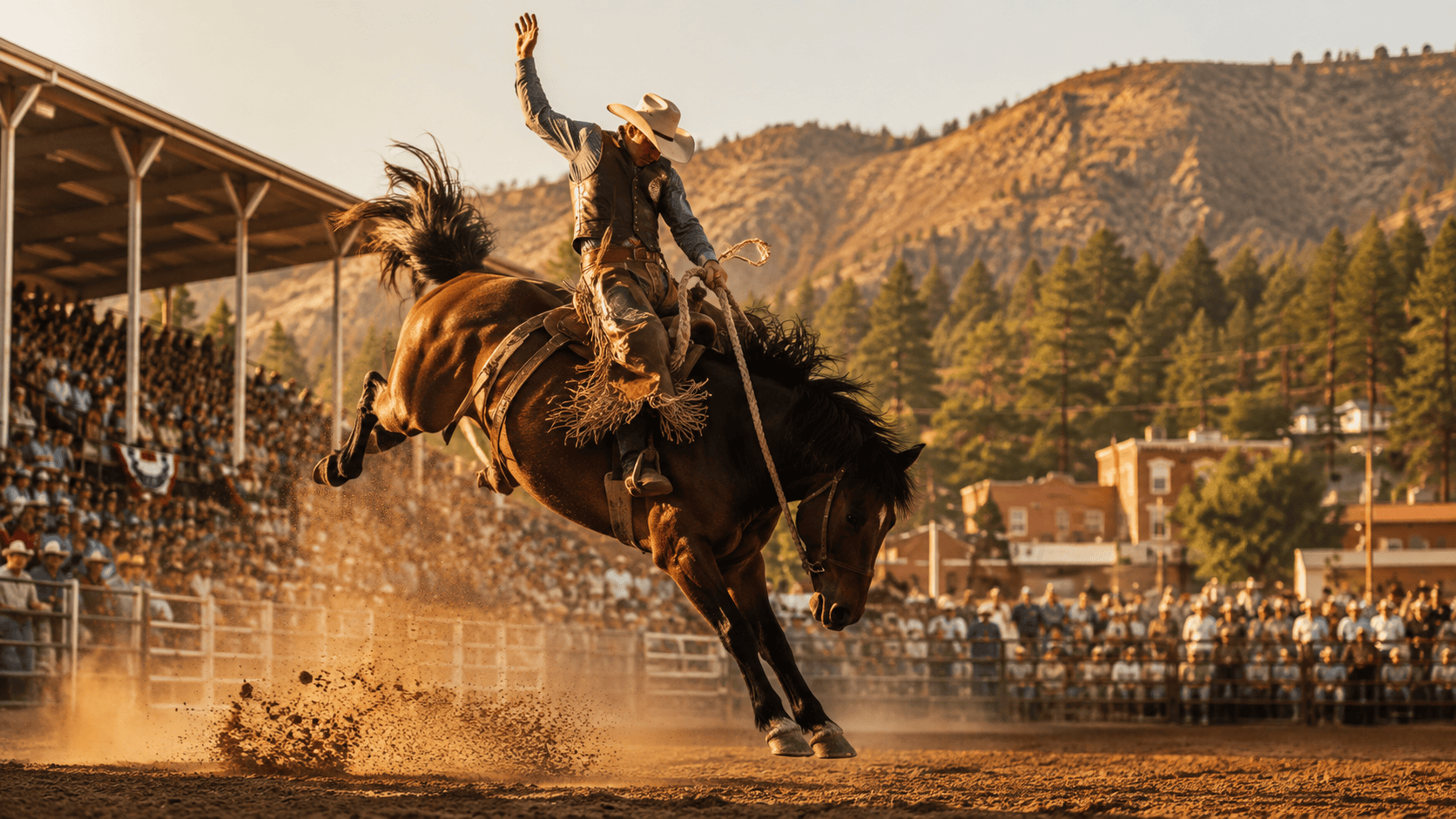
The modern World’s Oldest Rodeo runs for about a week around the Fourth of July, with roughly eight performances at the Prescott Rodeo Grounds. It draws tens of thousands of spectators a year and ranks among the top prize-money rodeos on the Professional Rodeo Cowboys Association circuit, which means the athletes you watch are among the best in the country, many of them chasing a spot at the National Finals Rodeo. Gates open early with food and retail vendors, and most performances start in the evening, with afternoon matinees on the weekend, so you have time to soak up the atmosphere before the first chute opens.
Insider Tip: Buy tickets the moment the schedule posts. The Fourth of July performances sell out and the whole town books solid that week, so lock in your seats and a room early. Then make a day of it, the Frontier Days parade winds through downtown in the morning and fireworks cap the holiday.
Get the Insider in your inbox
Local events, new places, and weekend ideas in one friendly email.
The events, explained
If you are new to rodeo, a quick rundown makes the night more fun to watch. In bareback and saddle bronc riding, cowboys try to stay aboard a bucking horse for eight seconds while a judge scores both the rider and the horse. Bull riding is the same idea with far higher stakes and the crowd on its feet. The timed events reward speed and precision: in tie-down roping a rider ropes a calf and ties three legs as fast as possible, in team roping two riders catch a steer’s head and heels, and in steer wrestling a cowboy leaps from a galloping horse to wrestle a steer to the ground. Barrel racing, the marquee women’s event, is a flat-out sprint around a cloverleaf of barrels where hundredths of a second decide the winner. Between the events, a barrelman and specialty acts keep the crowd entertained, and a good announcer ties the whole night together. Once you know what each event is testing, it is genuinely gripping to watch.
The stock behind the show
A rodeo is only as good as its animals, and the stock is a bigger part of the story than most first-timers realize. The bucking horses and bulls are athletes in their own right, bred and raised for the arena, and a great bucking bull can be as famous among rodeo fans as any cowboy. Prescott works with professional stock contractors who supply top-tier animals, and the quality of the stock is one reason the best competitors keep coming back, since a rider is scored partly on how hard the animal bucks. The animals are valuable and well cared for, working only a few seconds at a time. Watching a legendary bull send rider after rider into the dirt is one of the real thrills of a night at the rodeo.
More than a rodeo
Frontier Days is really a town-wide celebration wrapped around the rodeo. The Fourth of July in Prescott comes with a big western parade through downtown, live music, street vendors, dances, and fireworks, and the kind of community pride that fits a place that calls itself Everybody’s Hometown. For a week the whole town leans into its Western roots, and locals take real ownership of hosting the World’s Oldest Rodeo and welcoming the crowds that come for it. If you have read our history of Prescott, the rodeo will feel like a living extension of that story, the frontier past still playing out in the arena every summer rather than sitting behind glass in a museum.
Bringing the family
The rodeo is a genuinely good outing with kids. The action is easy to follow, the between-event acts are aimed squarely at younger fans, and there is plenty to see beyond the arena, from the animals to the vendors to the general Fourth of July energy. Many performances include moments meant for children, and the whole thing runs on a wholesome, community feel rather than anything rowdy. Bring ear protection for little ones if you are sensitive to the noise of the crowd and the announcer, pack layers for when the evening cools, and let the kids soak up a slice of the American West that most children only ever see in movies. It tends to leave a big impression.
Tips for your first rodeo
A few things make a first rodeo more enjoyable. Buy tickets ahead, since the Fourth of July performances are the most popular and sell out. Come early to browse the vendors, grab food, and find your seats before the grand entry. Dress for warm, sunny evenings, but bring a light layer, because at a mile high the temperature drops once the sun goes down. A hat and sunscreen help for the earlier part of the evening, and cash is handy for vendors. Family sections and general seating fill fast, so arriving early also gets you a better view. And do not rush off at the end, since the Prescott crowd and the small-town Fourth of July atmosphere are half the experience.
Where to stay during rodeo week
Fourth of July week is the single busiest stretch of the year in Prescott, so if you are traveling in, plan your lodging well ahead. The historic downtown hotels, like the Hassayampa Inn and the Hotel St. Michael, put you within walking distance of the parade and the Whiskey Row nightlife, and they book up early for the holiday. There are plenty of standard hotels along the highway and in nearby Prescott Valley and Chino Valley if downtown is full, and campers have options at the area lakes. The main thing is not to wait, because rooms near town go quickly once the calendar turns toward summer. Book early and you can spend the week walking to the rodeo instead of fighting holiday traffic.
How to go
If you want to catch it, plan around late June and the first days of July, since the rodeo is built around the Fourth. Tickets and the exact performance schedule are posted each year at the official site, worldsoldestrodeo.com, and popular nights sell out, so buy ahead if you can. Come early, dress in layers for the warm-to-cool evening, and give yourself time to enjoy the whole atmosphere, not just the eight seconds in the chute.
A living piece of the West
It is easy to take a rodeo for granted until you realize you are watching the direct descendant of the very first one. Prescott did not just host an old rodeo, it staged the event that turned cowboy skill into a professional sport, and it has kept that flame lit for well over a century without a single interruption. That is a rare thing to be able to say. For more on the town’s frontier history and the events that fill its calendar, browse our Events section and our things to do in Prescott guide, and join our free newsletter to keep up with what is coming next.
Something changed? Let us know
Enjoyed this? Get more Prescott in your inbox
Weekend picks, new places, and local events from people who love Prescott. Free, and you can unsubscribe anytime.