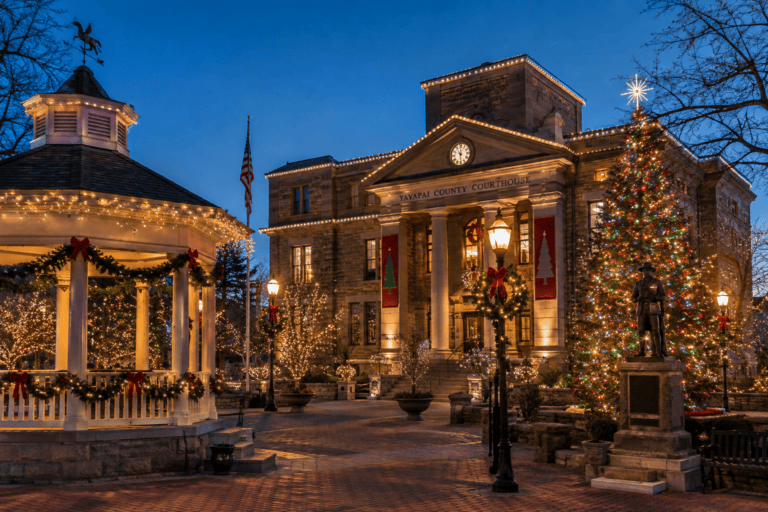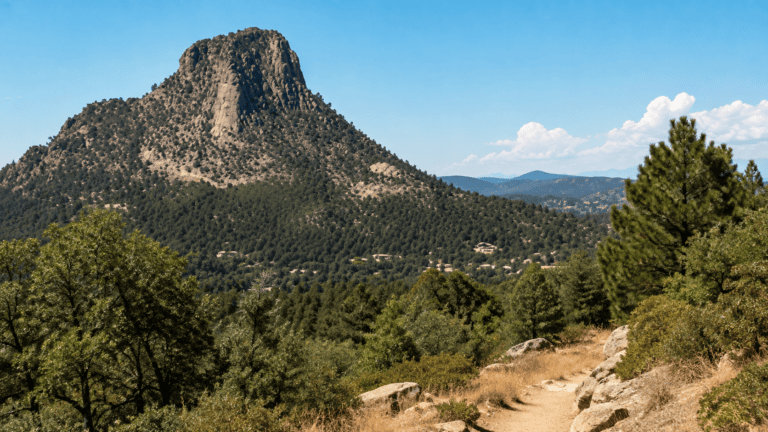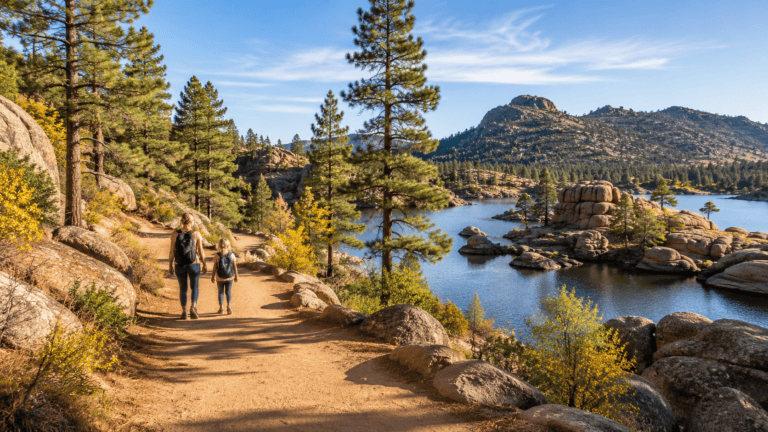
Prescott does not look like the rest of Arizona, and that is not an accident. Drive up from Phoenix and the saguaros give way to ponderosa pines, the temperature drops a good fifteen or twenty degrees, and you arrive at a courthouse square that looks like it was picked up somewhere in the Midwest and set down in the mountains. There is a reason for that, and it runs straight back to 1864, when a small group of men sent west by Abraham Lincoln decided this clearing in the pines would be the capital of a brand new territory.
The history of Prescott, Arizona is the story of how a gold camp became the seat of government for an entire territory, lost that job, won it back, lost it again for good, and grew into the role it holds today. Locals call it Everybody’s Hometown, and once you know how the place came together, the name makes sense.
In this article
- Gold, Lincoln, and a war that needed money
- How the town got its name
- The people who were already here
- Capital, then not, then capital again
- Whiskey Row and the night it burned
- The courthouse, the plaza, and the Rough Rider
- The woman who saved the story
- What Prescott became
- The history you can still walk through
Gold, Lincoln, and a war that needed money
Arizona became a United States territory in February 1863, in the middle of the Civil War. The timing was not a coincidence. The Union was short on cash, and the mountains of central Arizona were rumored to be full of gold. Organizing the region as its own territory was partly a bet that its mineral wealth could help fund the war effort and stay in Union hands.
The rumors turned out to be true. In 1863 an expedition led by Joseph Walker worked its way into the mountains and found gold along Granite Creek and Lynx Creek. Word spread the way it always did, and prospectors and traders started filling the creek beds and gulches. By the time the territorial government arrived, mining camps were already scattered through the hills.
That government took its time getting there. The first man Lincoln appointed as territorial governor, John Gurley, died in the summer of 1863 before he ever left for the West. John Noble Goodwin of Maine took his place and made the long trip out by train, riverboat, and finally horseback. On December 29, 1863, at Navajo Springs near the New Mexico line, territorial secretary Richard McCormick raised the flag and swore Goodwin into office. Arizona had a government, but it still did not have a capital.
How the town got its name
The official party spent a few months at a military camp at Del Rio Springs in Chino Valley, then moved about twenty miles south to the banks of Granite Creek, into an open stretch of tall ponderosa pines with ridges around it for shelter. That is where they laid out the capital. Fort Whipple, the military post named for Lieutenant Amiel Whipple, moved with them and gave the settlers some protection.
On May 30, 1864, the new officials held a public meeting to name the place. The suggestions were a mixed bag. Goodwin City, after the governor. Audubon, after the naturalist. Aztlan, because a lot of people at the time genuinely believed the Aztecs had once lived in the area. One account even lists Gimletville. Richard McCormick, who had hauled a small library west with him, owned a copy of a best selling book by the historian William Hickling Prescott called The History of the Conquest of Mexico. McCormick had a gift for a speech, and he made the case for naming the town after the author. The name stuck.
There is a small irony in that. William Hickling Prescott was a celebrated East Coast historian, considered by many the first serious scholar of history in America, and he had died in 1859, five years before the town existed. He never set foot in Arizona. He got the honor mostly because his books were popular with the educated settlers, who wanted their frontier capital to feel like it had some culture.
The town’s namesake was a Boston historian who had died five years earlier and never once set foot in Arizona.
One more thing worth knowing, because it is the fastest way locals will peg you as an outsider. It is pronounced PRES-kit, like biscuit. Not Pres-cott. The town has been correcting visitors on this for more than a century, so consider yourself warned.
The people who were already here
It is easy to tell the founding as a clean adventure story, but the honest version has to include who was pushed aside to make room. While the settlers were busy inventing an Aztec past for the ruins in the area, they were driving out the people who actually lived there, the Yavapai. The same gold that pulled prospectors into the hills brought conflict with it, and Fort Whipple existed in large part to protect miners and settlers during those years. The Yavapai were forced off their land, and the story of Prescott’s founding and the story of that displacement are the same story. The Yavapai-Prescott Indian Tribe is still here today, with a reservation bordering the city.
Capital, then not, then capital again
Prescott’s claim to the capital was never all that secure. When the first territorial legislature voted on where to put the seat of government, Prescott reportedly beat out La Paz by a single vote. It held the title for only a few years. In 1867 the capital was moved to Tucson, which was bigger and had been lobbying hard for it.
Prescott got a second turn. In 1877 the capital came back north, and for another decade the little mountain town ran the territory again. Then, in 1889, the legislature moved the capital to Phoenix, where it has stayed ever since. Phoenix was central, it was growing fast, and the railroads made it easy to reach. Prescott lost the capital for good, but by then it had something a title could not give it, a real town with a real economy built on mining, ranching, and timber.
That back and forth left a mark. Prescott had been built to be a capital, laid out by Midwesterners and New Englanders, full of wood frame buildings and a proper town square, and it kept that character long after the government left. To this day it feels less like a desert town and more like a New England county seat that happened to land in the pines.
Whiskey Row and the night it burned
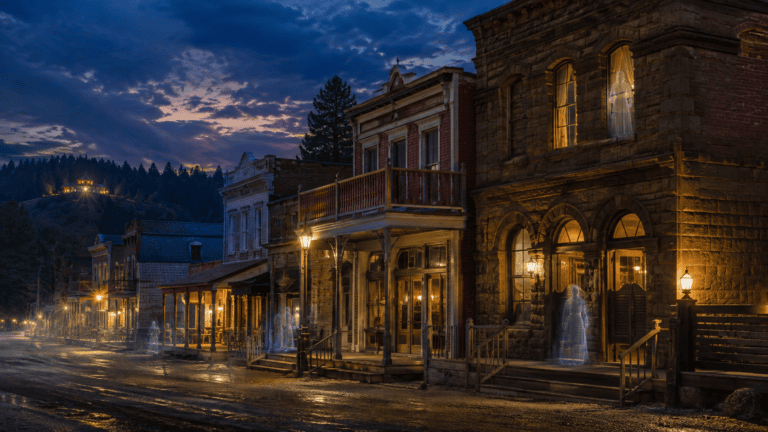
No part of Prescott’s past gets told more often than Whiskey Row, the single block on the west side of South Montezuma Street facing the courthouse plaza. At its peak the block packed in something like forty saloons side by side, serving the miners, cowboys, gamblers, and drifters who came through. Deals got made there. Mining claims changed hands over the bar. Politicians worked the room during elections. Wyatt Earp spent time on the Row while visiting his brother Virgil, who lived in Prescott, served as a constable, and ran a sawmill out near Thumb Butte.
Then came July 14, 1900. The fire started in the O.K. Lodging House, most likely from a candle left burning in a wall. It should have been easy to stop, except the town’s water pump had been torn apart for repairs at the worst possible moment, and there was no water to fight it. The flames jumped from building to building, crossed streets people swore they could never cross, and burned through roughly five blocks of downtown before they were done. The loss ran to something like a million and a half dollars, an enormous sum at the time.
The most famous piece of that night belongs to the Palace Saloon, which had opened in 1877 and is the oldest continuously operating business in Arizona. As the fire closed in, a crowd of patrons, remembered as around fifty men, refused to let the saloon’s hand carved Brunswick bar burn. They hauled the massive thing out the door and across the street to the courthouse plaza, set it back up on the grass, and kept right on drinking while they watched the Row go up in smoke. Someone even carried out a piano and played it. The bar survived, and if you walk into the Palace today, that is the same bar you will be standing at.
They set the bar up on the grass and kept right on drinking while they watched the Row go up in smoke.
What happened next says a lot about the town. Merchants set up temporary shops on the plaza almost before the ashes cooled, and within months a new Whiskey Row was going up, this time in brick instead of wood. The block you walk down now is that rebuilt version, and a handful of the original fixtures, the Palace bar among them, made it through.
The courthouse, the plaza, and the Rough Rider
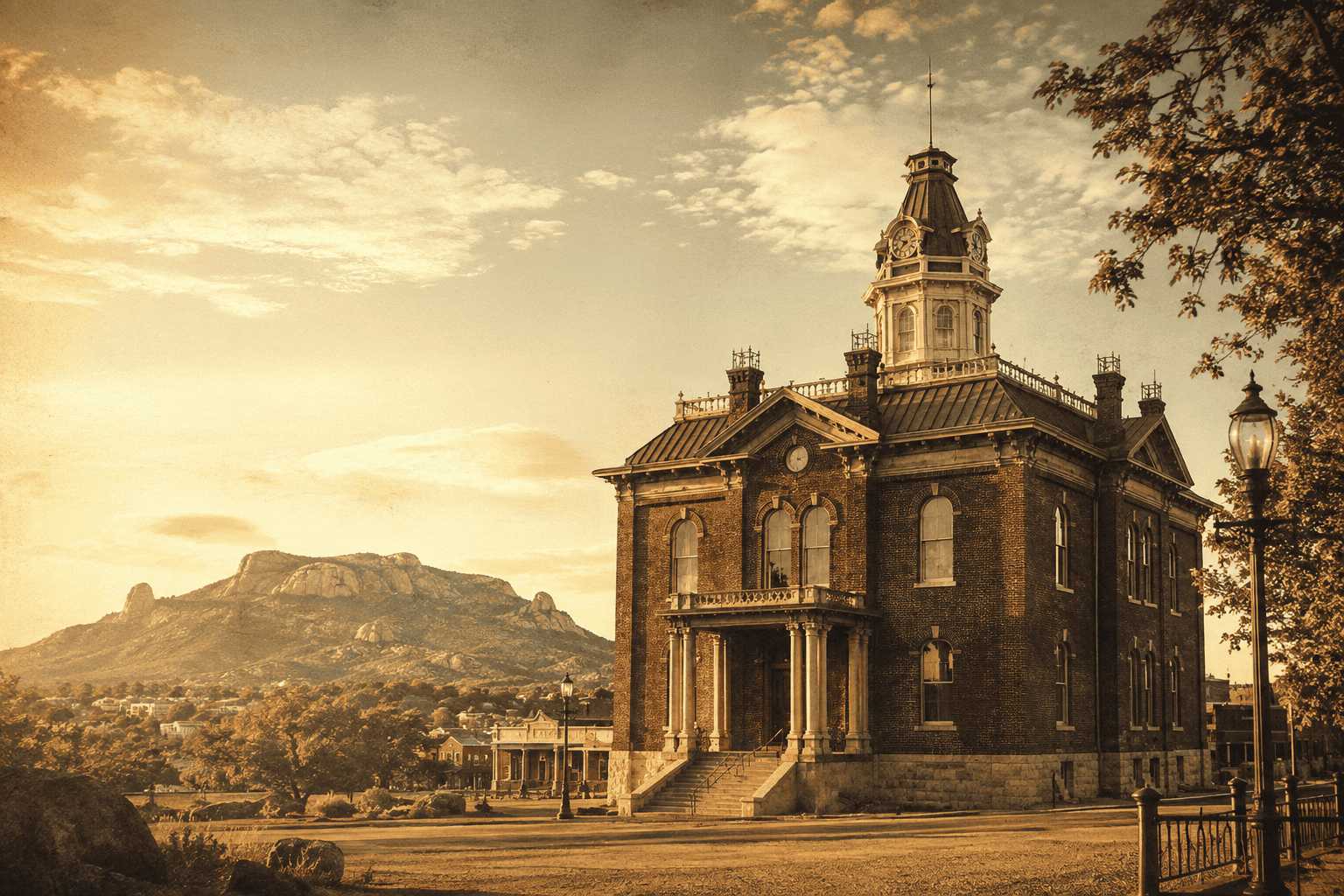
The center of Prescott, then and now, is the Yavapai County Courthouse and the plaza around it, though the building itself has changed. The first real courthouse went up in 1878, a two story red brick Victorian building put up by contractor George Waters, with sandstone from the Verde Valley on the lower floor, local brick above, and a clock tower whose 800 pound bell was shipped all the way from Boston. It became the symbol of young Yavapai County almost overnight, and it heard cases through the years when Prescott was the territorial capital. It also had a hard life. Fire broke out in 1892 when rainwater seeped into the basement and mixed with lime, and by the 1910s the building was crumbling and considered a fire hazard.
The courthouse that stands today is its replacement, built between 1916 and 1918, four years after Arizona became a state. Architect William N. Bowman designed it in a Classical Revival style, cast in concrete and clad in granite and terra cotta on a foundation of locally quarried stone. It is the gray, columned building that anchors the plaza now, and it still runs the county.
Out on the plaza stands the statue most people stop to photograph, a bronze horseman known as the Bucky O’Neill monument. William “Bucky” O’Neill was about as Prescott as a person could be. He worked as a printer and a court reporter, served as sheriff, got elected mayor, ran a newspaper, and promoted a railroad to serve the mines. When the Spanish-American War broke out he joined Teddy Roosevelt’s Rough Riders, and he was killed at the Battle of San Juan Hill in 1898. The memorial was dedicated in 1907. It was sculpted by Solon Borglum, whose brother Gutzon would later carve Mount Rushmore, and the copper in the bronze was donated by local mining and smelting companies, so the metal itself came out of the Yavapai County hills.
The courthouse steps have had their moments in national history too. In 1964, Senator Barry Goldwater stood on them to announce that he was running for president.
The woman who saved the story
A lot of what we know about early Prescott survives because of one person, Sharlot Hall. She was a poet and a historian, and in an era when women held almost no public office anywhere, she became the Territorial Historian of Arizona, the first woman to hold a salaried territorial position. She spent her life gathering the documents, photographs, and objects of the frontier era before they could vanish. She took over the old log Governor’s Mansion, one of the original territorial buildings, and turned it into a museum. That museum still operates under her name, the Sharlot Hall Museum, and it is the best place in town to see the founding era up close.
What Prescott became
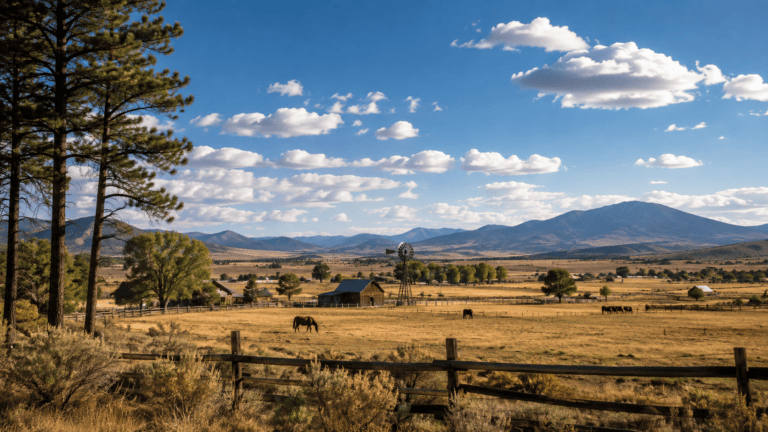
Once the capital was gone, Prescott leaned into what it had. Mining kept the region going for decades, ranching spread across the grasslands out toward Chino Valley and Dewey, and the ponderosa forests fed a timber industry. Fort Whipple, which had started as a frontier outpost, went through a long second life as a military hospital and eventually became a Veterans Affairs medical center, which it remains. Sitting at about a mile high, with four real seasons and summers far cooler than the desert below, the town also drew people who came for their health and, later, simply to escape the Phoenix heat.
Today Prescott anchors what locals call the Quad Cities, the cluster of Prescott, Prescott Valley, Chino Valley, and Dewey-Humboldt that shares this stretch of high country. The other three grew up around the same mines, ranches, and rail lines, and the four communities still function as one connected area, which is exactly the corner of Arizona we cover.
The history you can still walk through
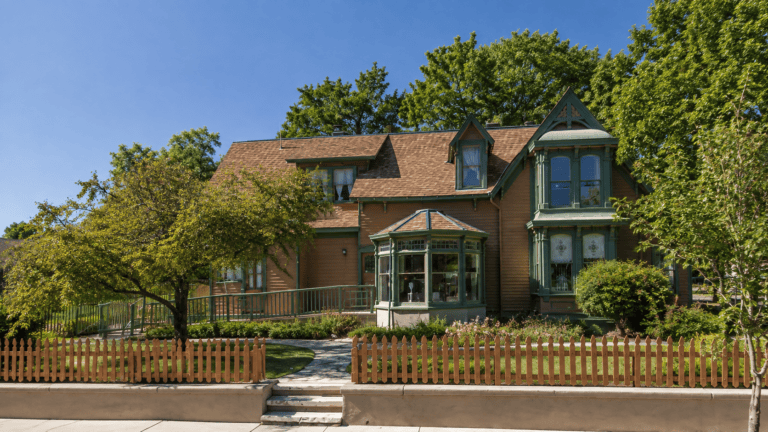
What makes Prescott unusual is how much of this is still standing and still in use. The courthouse still runs the county. The Palace still pours drinks over the bar that got carried across the street in 1900. The plaza where merchants set up shop after the fire is where families still spread blankets for summer concerts. The town has kept the World’s Oldest Rodeo going since 1888, and the Victorian houses on the hills above downtown are lived in, not roped off.
That is really the throughline of the history of Prescott, Arizona. It was built to be a capital, it lost the job twice, and instead of fading it turned into the kind of town people drive up the mountain to visit and end up wanting to move to. Everybody’s Hometown is a marketing phrase, but it landed on something real. If you want more of the stories and history worth knowing around here, our History and Heritage section is a good place to start, and you can get the highlights in your inbox through our free newsletter.