
The Best Time to Visit Prescott, Arizona: Weather by Month, Seasons, and Events
Fact-checked How we check
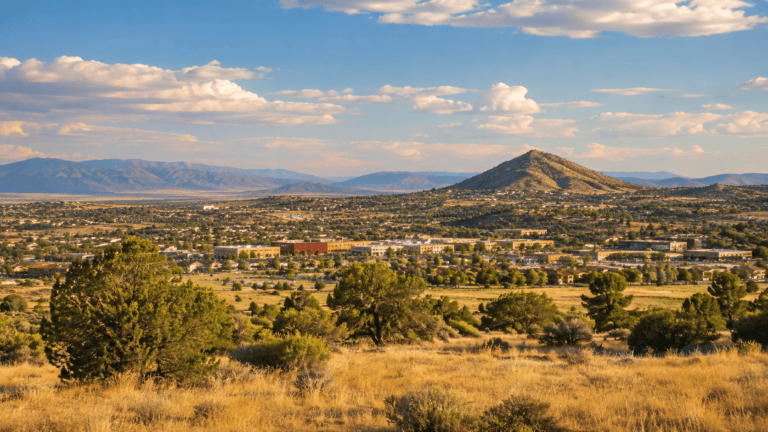
Prescott’s weather is one of the biggest reasons people fall for the place. At roughly a mile high, it’s dramatically cooler than Phoenix in summer, it gets real seasons, and it still sees plenty of sun. But “the best time to visit” depends on what you want: hiking weather, fall color, a summer escape from the desert, the Christmas City lights, or a quiet off-season weekend. This guide breaks down Prescott’s weather month by month using NOAA’s official 1991–2020 climate averages, explains what each season actually feels like, and lists the events worth building a trip around.
| Best overall | Late September through October, and April through May |
| Summer escape | July highs average about 90°F, roughly 17 degrees cooler than Phoenix |
| Wettest months | July and August (monsoon storms, usually in the afternoon) |
| Snow | About 10 inches a year on average, mostly December through March |
| Busiest times | Rodeo week around July 4, fall weekends, and the December Christmas City season |
The short answer
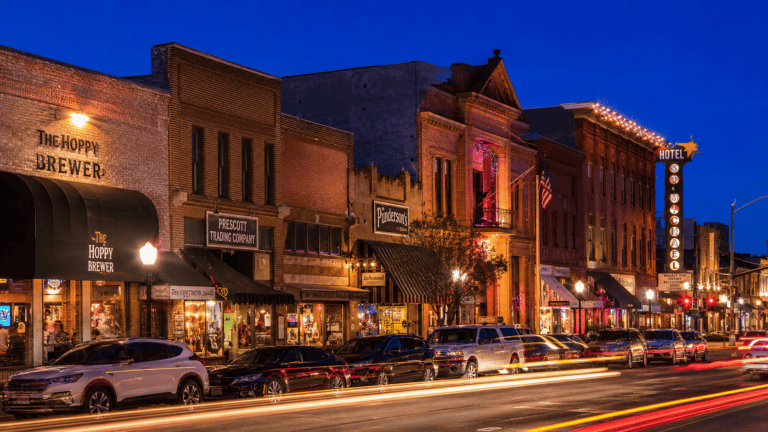
If you can pick any time, come in late September or October. Days are sunny and in the 70s, nights are crisp, the monsoon is over, and fall color arrives in late October. April and May are a close second, with mild, dry weather that’s perfect for hiking. Summer is the classic escape from the Valley heat, as long as you plan outdoor time for the mornings. And December is its own reason to visit, when Prescott becomes Arizona’s Christmas City. The City of Prescott says the town averages about 277 sunny days a year, so there’s rarely a truly bad time to come.
Prescott weather by month
These are NOAA’s official 1991–2020 averages for the Prescott weather station (station USC00026796, at about 5,200 feet). Expect a few degrees of difference around town; the airport station north of town runs slightly warmer at night.
| Month | Avg high | Avg low | Rain/melted snow | Snow |
|---|---|---|---|---|
| January | 53°F | 24°F | 1.52 in | 1.9 in |
| February | 55°F | 26°F | 1.78 in | 3.1 in |
| March | 61°F | 32°F | 1.46 in | 2.5 in |
| April | 68°F | 37°F | 0.57 in | 0.4 in |
| May | 76°F | 45°F | 0.51 in | 0 |
| June | 87°F | 54°F | 0.23 in | 0 |
| July | 90°F | 61°F | 2.69 in | 0 |
| August | 87°F | 60°F | 2.78 in | 0 |
| September | 82°F | 52°F | 1.64 in | 0 |
| October | 73°F | 40°F | 0.96 in | 0 |
| November | 62°F | 30°F | 0.87 in | 0.9 in |
| December | 52°F | 24°F | 1.45 in | 1.4 in |
| Year | 71°F | 40°F | 16.46 in | 10.2 in |
Source: NOAA National Centers for Environmental Information, U.S. Climate Normals 1991–2020, Prescott (USC00026796). Temperatures rounded to the nearest degree.
Two things jump out. First, the big day-to-night swing: lows run roughly 30 degrees below the highs most of the year, so even a warm afternoon turns into a jacket evening. Second, Prescott’s rain comes in two seasons, a winter wet season from December through March and the summer monsoon in July and August, with a dry stretch in between in April, May, and June.
Spring (March through May)
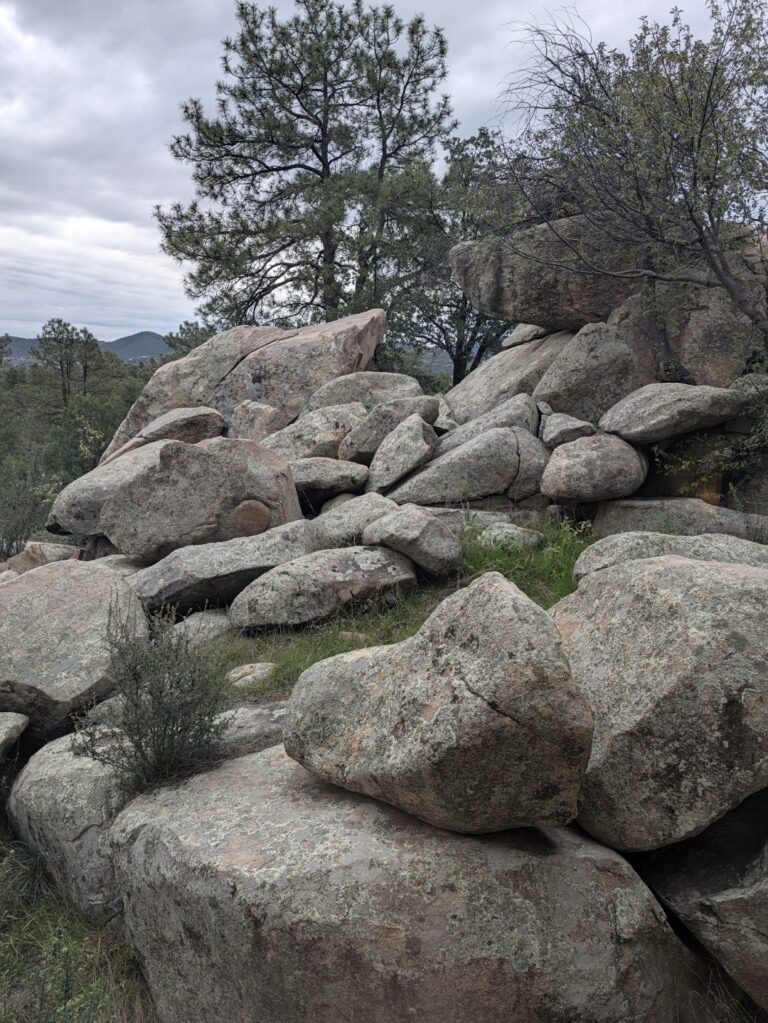
Spring warms up fast. March can still bring a late snowfall and freezing nights, but by April afternoons are in the upper 60s, and May averages a sunny 76°F. April through June is also the driest stretch of the year, which makes it prime hiking season on the granite trails around the Dells and Thumb Butte before summer heat arrives. On average, the last spring freeze in town comes around the end of April, so gardeners (and campers) shouldn’t trust early warm spells.
Worth planning around: the Whiskey Off-Road mountain-bike race and festival takes over downtown each spring (April 30 to May 2 in 2027), and the Phippen Museum’s Western Art Show & Sale fills the Courthouse Plaza over Memorial Day weekend.
Summer (June through August)
Summer is when Prescott earns its reputation as the Valley’s cool getaway. July, the hottest month, averages about 90°F in Prescott, compared with about 106.5°F in Phoenix, and nights drop into the low 60s. June is usually hot and very dry, with fire restrictions common in the national forest, so check before you plan a campfire.
Then comes the monsoon. The National Weather Service defines Arizona’s monsoon season as June 15 through September 30, and in Prescott, July and August are the wettest months of the year. The typical pattern is a clear, warm morning followed by towering clouds and short, intense thunderstorms in the afternoon. Plan hikes and lake time for the morning, get off exposed ridges and summits when storms build, and never drive into a flooded wash.
Worth planning around: Prescott Frontier Days and the World’s Oldest Rodeo run the week leading up to July 4 (June 28 through July 4 in 2027), the free Prescott Bluegrass Festival fills the plaza in June, the Prescott Film Festival runs in July, and the plaza hosts free summer concerts. Rodeo week is the busiest time of the year, so book lodging early. See our guide to the World’s Oldest Rodeo.
Insider Tip: Summer afternoons at a mile high still feel hot in direct sun. Do the big hike or the kayak early, save the afternoon for museums, lunch, and the shops around the plaza, and head back out for the evening when the storms clear and the air cools down.
Fall (September through November)
Fall is Prescott at its best. September is still warm, with highs in the low 80s and the last of the monsoon storms. By October, days settle into the low 70s with cool, clear nights, and rain is scarce. The first fall freeze in town typically arrives around late October. Fall color follows the elevation down the mountains: the high country goes first in early to mid-October, and the cottonwoods along Granite Creek, the lakes, and Watson Woods usually peak from late October into early November. Our Fall Color Report tracks it in season, and our guide to fall in Prescott covers the best spots.
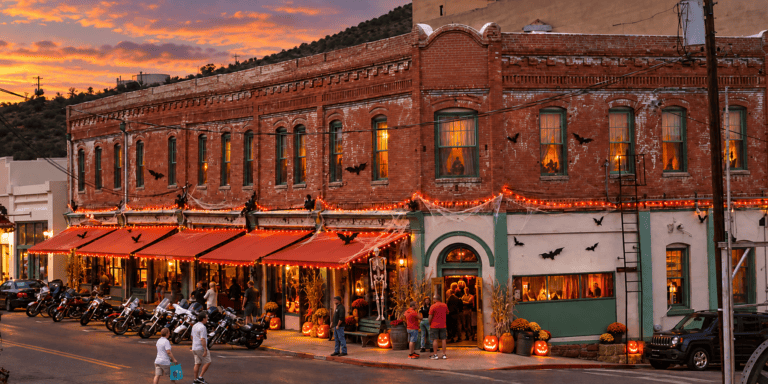
Worth planning around: the Prescott Indian Art Market at Sharlot Hall Museum in September, Sharlot Hall’s Folk Music Festival in early October, the Whiskey Row Marathon in October, and a full month of Halloween fun, from ghost tours to pumpkin patches. November is quieter, with highs in the low 60s.
Winter (December through February)
Winter is cool and often sunny, with highs in the low to mid 50s and nights in the mid 20s. Prescott averages about 10 inches of snow a year, with February the snowiest month, and it usually comes in a few storms that melt off within days rather than lingering all season. A fresh dusting on the Courthouse Plaza or the Granite Dells is one of the prettiest sights in Arizona, but roads can ice up, so check conditions before you drive up from the Valley. Our guide to snow in Prescott covers what to expect.
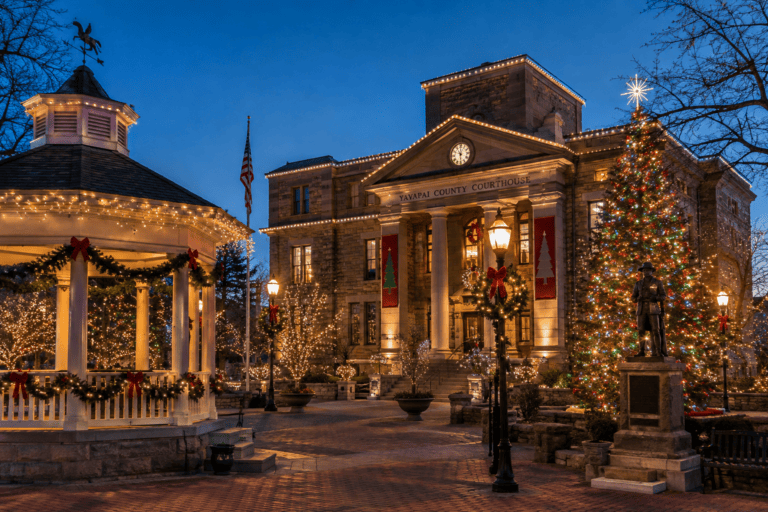
Worth planning around: December is Christmas City season, with the Christmas Parade and Courthouse Lighting on the first Saturday of December, Acker Night’s free live music downtown in mid-December, the plaza lights glowing nightly through Martin Luther King Jr. Day, and the Whiskey Row Boot Drop on New Year’s Eve. January and February are typically the quietest months of the year, and often the easiest time to find a room.
Get the Insider in your inbox
Local events, new places, and weekend ideas in one friendly email.
Records and extremes
At Prescott’s airport, where records go back to 1948, the hottest temperature on record is 105°F, on June 20, 2016, and the coldest is –9°F, on December 23, 1990, according to the Arizona State Climate Office. On average, the airport sees about 121 nights a year at or below freezing, about 46 days at 90 degrees or warmer, only about two days at 100 or above, and about 61 days with measurable rain or snow.
Two weather stations, two sets of numbers
If you’ve seen slightly different averages for Prescott elsewhere, this is why. NOAA keeps official records at two stations: the long-running cooperative station in town, used in the table above, and the station at Prescott Regional Airport, about seven miles north. The Arizona State Climate Office’s Prescott summary uses the airport numbers. The airport tends to run a couple of degrees warmer at night, and it records less precipitation over a year. Here are the airport’s 1991–2020 normals for comparison:
| Month | Avg high | Avg low | Precipitation |
|---|---|---|---|
| Jan | 53°F | 26°F | 1.21 in |
| Feb | 56°F | 29°F | 1.28 in |
| Mar | 62°F | 34°F | 0.96 in |
| Apr | 69°F | 39°F | 0.47 in |
| May | 77°F | 47°F | 0.47 in |
| Jun | 88°F | 56°F | 0.35 in |
| Jul | 90°F | 63°F | 1.87 in |
| Aug | 88°F | 61°F | 2.46 in |
| Sep | 83°F | 54°F | 1.27 in |
| Oct | 73°F | 42°F | 0.83 in |
| Nov | 62°F | 32°F | 0.69 in |
| Dec | 52°F | 26°F | 0.99 in |
Source: NOAA 1991–2020 normals, Prescott Love Field (USW00023184).
Freeze dates and the growing season
For gardeners, and for anyone wondering when to bring in the patio plants, NOAA’s typical freeze dates (the dates by which there’s an even chance of the last spring freeze or the first fall freeze at 32 degrees) are around April 30 and October 20 in town, for a frost-free season of about 172 days. At the airport, they’re around April 20 and October 27, about 188 days. Hard freezes of 28 degrees or colder typically end around mid-April in town and return around the end of October. In practice, tender plants go out in May and come in by mid-October, and you’ll want to protect outdoor pipes and hoses from late fall through early spring.
Sun, altitude, and staying comfortable
At more than 5,000 feet, the sun is stronger than it feels, especially on cool, clear days, so wear sunscreen and a hat even in winter. The air is dry, too, which means you’ll want more water than usual, particularly on the trail. Most people don’t notice the elevation much in town, but if you’re coming from sea level you may feel a little winded on your first steep hike, so take it easy the first day.
The best time for…
- Hiking: April, May, and late September through November. Summer mornings work too. Find a trail in our Trail Finder.
- The lakes and kayaking: May through October. City lake parks are open 6 a.m. to 10 p.m. from April through October and 7 a.m. to 6 p.m. from November through March; parking is $5 per vehicle and free on Wednesdays. See our lakes guide.
- Fall color: mid-October through early November.
- Snow: December through March, but check the forecast; snow in town rarely lasts long.
- Escaping the heat: June through August, ideally avoiding the July 4 rodeo week if you don’t want crowds.
- Smaller crowds: weekdays, January and February, and early November.
- Events: early July (rodeo), October (Halloween and fall), and December (Christmas City). Check our annual events guide and events calendar.
What to pack, any time of year
Layers, always. Even in summer, a 30-degree drop from afternoon to night is normal, so here’s a season-by-season checklist:
- Winter (December through February): a warm coat, hat, gloves, and boots or shoes with grip. Mornings often start below freezing even when afternoons are sunny.
- Spring (March through May): layers, a light jacket, and a windbreaker. March and early April can still be wintry, while May can feel like summer.
- Summer (June through September): shorts and sun protection for the day, a light layer for evenings, and a rain jacket from July through mid-September.
- Fall (October and November): a fleece or sweater for crisp evenings, plus a warmer coat by November.
- Year-round: sunscreen, sunglasses, a refillable water bottle, and comfortable walking shoes for downtown and the trails.
If you’re driving up from the Valley in winter, check road conditions first; our Phoenix to Prescott driving guide covers routes, winter tips, and the airport shuttle. For the rest of your trip planning, start with our guide to visiting Prescott and where to stay.
Quick answers
What is the best month to visit Prescott?
October. Highs average about 73°F, it’s one of the drier months, and fall color peaks in town late in the month. April, May, and September are close behind.
How hot does Prescott get in summer?
July is the hottest month, with an average high of about 90°F and lows around 61°F, according to NOAA’s 1991–2020 normals. That’s roughly 17 degrees cooler than Phoenix’s July average high.
Does it snow in Prescott?
Yes, but not a lot. Prescott averages about 10 inches of snow a year, mostly from December through March, with February the snowiest month. Snow in town usually melts within a few days.
When is monsoon season in Prescott?
The National Weather Service defines Arizona’s monsoon season as June 15 through September 30. In Prescott, most of the monsoon rain falls in July and August, usually as afternoon thunderstorms.
Whatever season you choose, Prescott rewards a visit. Pick the weather you like best, pack layers, and we’ll see you up the mountain.
Something changed? Let us know
Enjoyed this? Get more Prescott in your inbox
Weekend picks, new places, and local events from people who love Prescott. Free, and you can unsubscribe anytime.