Sullivan Lake: The Unfinished 1930s Dam Where the Verde River Begins
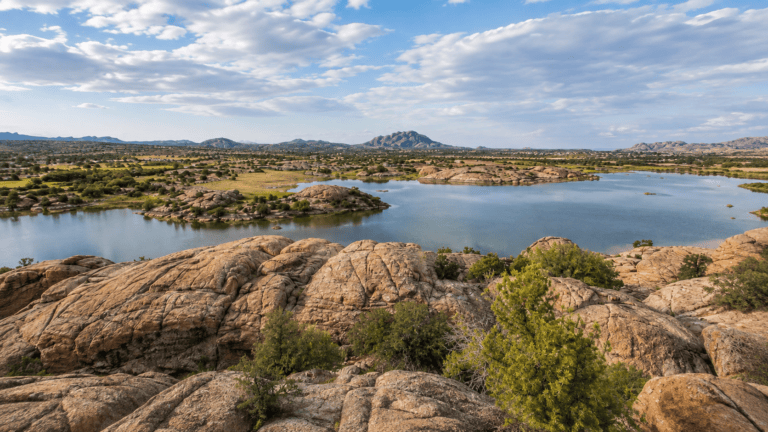
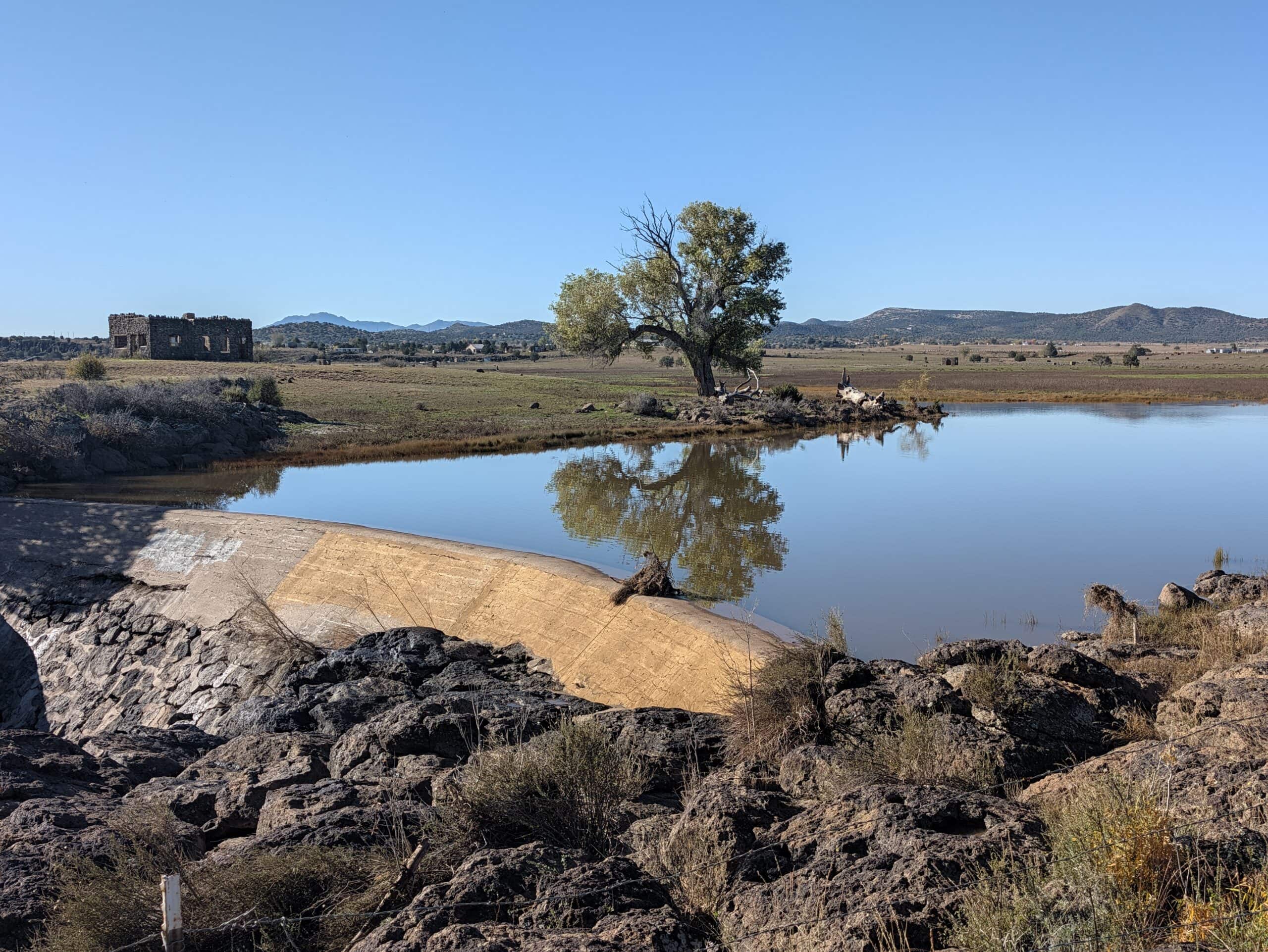
About 25 miles north of downtown Prescott, between Chino Valley and Paulden, a small concrete dam sits in a notch of black volcanic rock. Behind it is Sullivan Lake, which is usually more of a marshy pond than a lake. Below it, a narrow basalt canyon opens up, and that canyon is where the Verde River begins. The dam was built in the 1930s to make a fishing and duck-hunting lake for Prescott sportsmen. Within a few years it had filled with silt, and the stone clubhouse planned for the shore was never finished. Its walls are still standing. Here’s the story of Sullivan Lake, what you can see there today, and why it’s about to become part of Arizona’s newest state park.
| Where | Old Highway 89, about 2.7 miles south of Paulden and north of Chino Valley |
| Built | Mid-1930s, as a New Deal work-relief project |
| Why it matters | The Verde River starts just below the dam |
| Also here | An unfinished stone clubhouse, a 1922 arch bridge on the National Register, and an old railroad bridge |
| Status | Part of the planned Verde River Headwaters State Park, which isn’t open yet |
A sportsmen’s lake at the head of the Verde
The idea came from the Prescott Sportsmen Club in the mid-1930s. According to local historians, the club talked the City of Prescott into buying 160 acres where the upper Verde enters its canyon, with a plan to dam the gorge, stock the lake with fish, and draw ducks for hunters. The Great Depression supplied the labor. The dam became a federal work-relief job, one of the many New Deal projects that put Arizonans to work building roads, schools and dams.
The paper trail shows how early the work started. A 1935 photo in the Arizona State Archives, credited to the Federal Emergency Relief Administration, already shows water behind “Sullivan Dam.” Sharlot Hall Museum’s archive holds a series of construction photos dated about 1934 to 1938 and credits the Works Progress Administration, the agency that took over most federal relief work in 1935. Local accounts date the finished dam to 1937 or 1938.
The dam was built on solid rock, and that’s probably why it’s still here. Big floods have poured over the top more than once; local historians have photos of the dam completely under water in February 1993 and again in February 2005.
Why the lake didn’t last
What the planners missed was the silt. Sullivan Lake collects runoff from a huge stretch of open country: Big Chino Wash, Williamson Valley Wash, Little Chino Creek and Granite Creek all drain toward this one gap in the rock. Every monsoon storm carried mud downstream, and within a few years, local historians say, the lake was only about 2 feet deep at the dam. Dredging was too expensive for the city and the club, and later talk of digging it out was dropped after the weight of the silt was found to have cracked the dam.
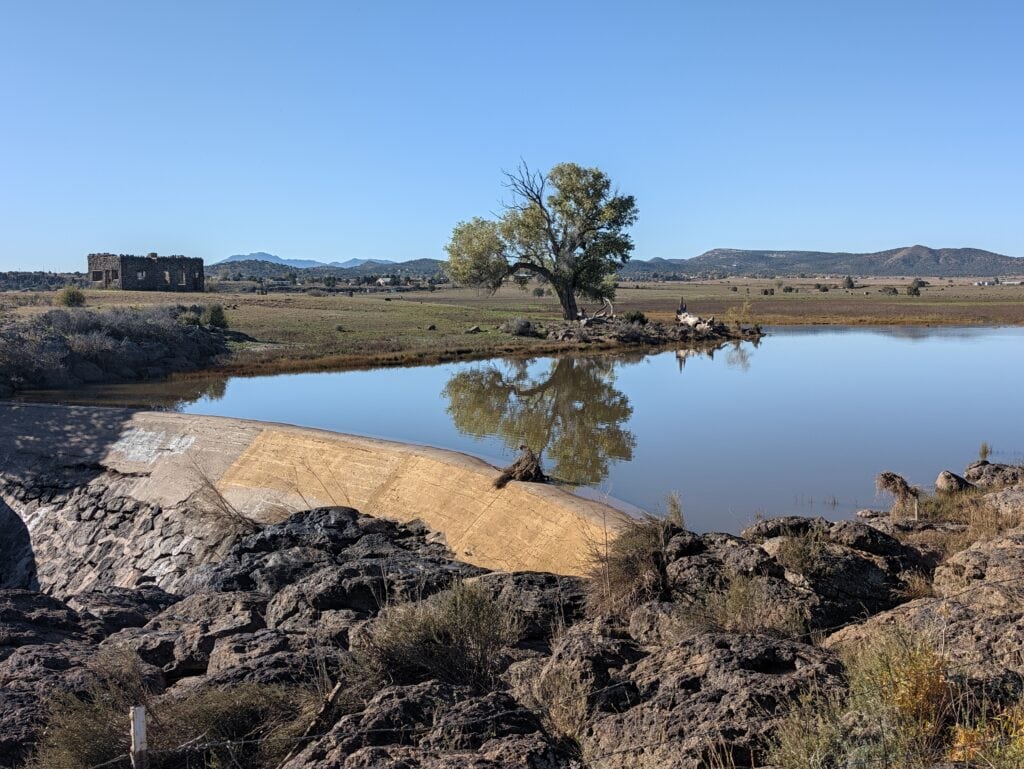
Today Sullivan Lake is a shallow, reedy basin that holds water after rain and is often dry. When we stopped by on November 18, 2026, there was water behind the dam, a cottonwood reflected on the surface, and the old clubhouse walls stood across the water.
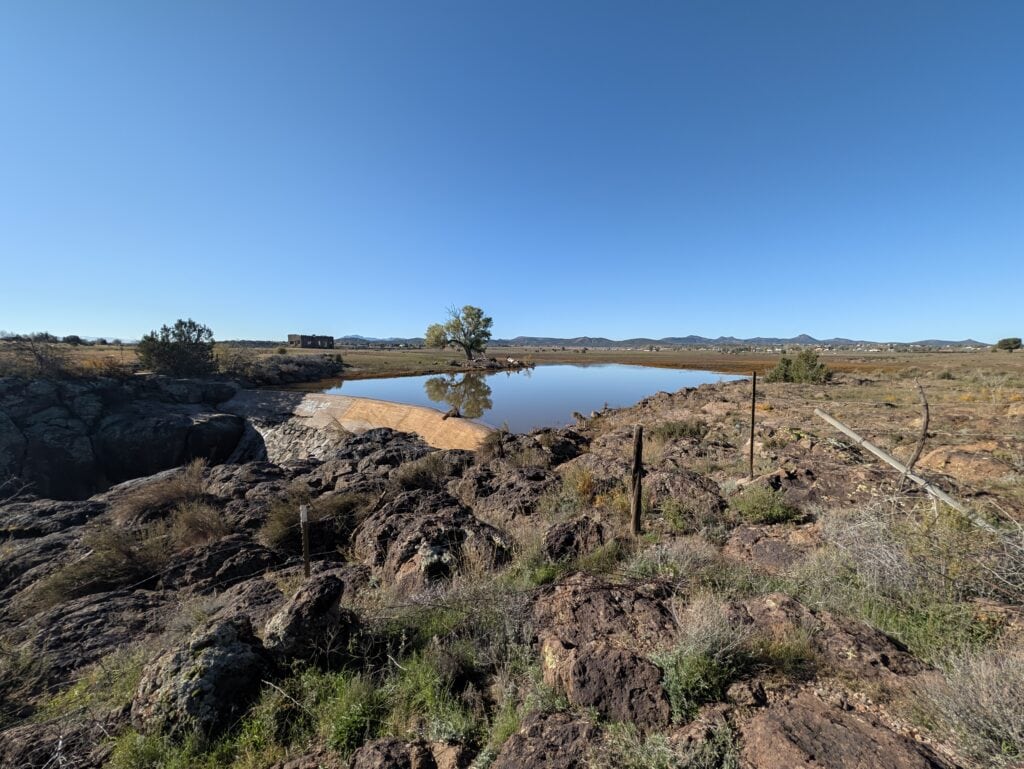
The clubhouse that was never finished
The stone building on the far shore is usually called a ruin, but it’s really an unfinished building. The larger structure was meant to be the Sportsmen Club’s clubhouse, and smaller stone structures around the lake were meant to be permanent duck blinds. Trees were planted along the shore. Then the money ran out. Local accounts say the work stopped for good when the United States entered World War II and federal relief projects wound down. The walls went up, the roof never did, and the building has stood open to the sky for more than 80 years.
Where the Verde River begins
The Verde is one of Arizona’s few rivers that still flows year-round for most of its length, running about 170 miles from here to the Salt River near Phoenix. This is where it starts. The Verde begins just below Sullivan Dam, where the drainage of the Big Chino and Williamson valleys funnels into the canyon. The spot is sometimes called “mile zero” of the Verde River.
Don’t expect a rushing stream. The canyon right below the dam is dry most of the time, a jumble of basalt boulders with pools after storms. The river’s steady flow comes from springs a little farther downstream. Historically, Del Rio Springs, a couple of miles south, also fed the upper river through Little Chino Creek, and the springs have been a big part of the area’s story.
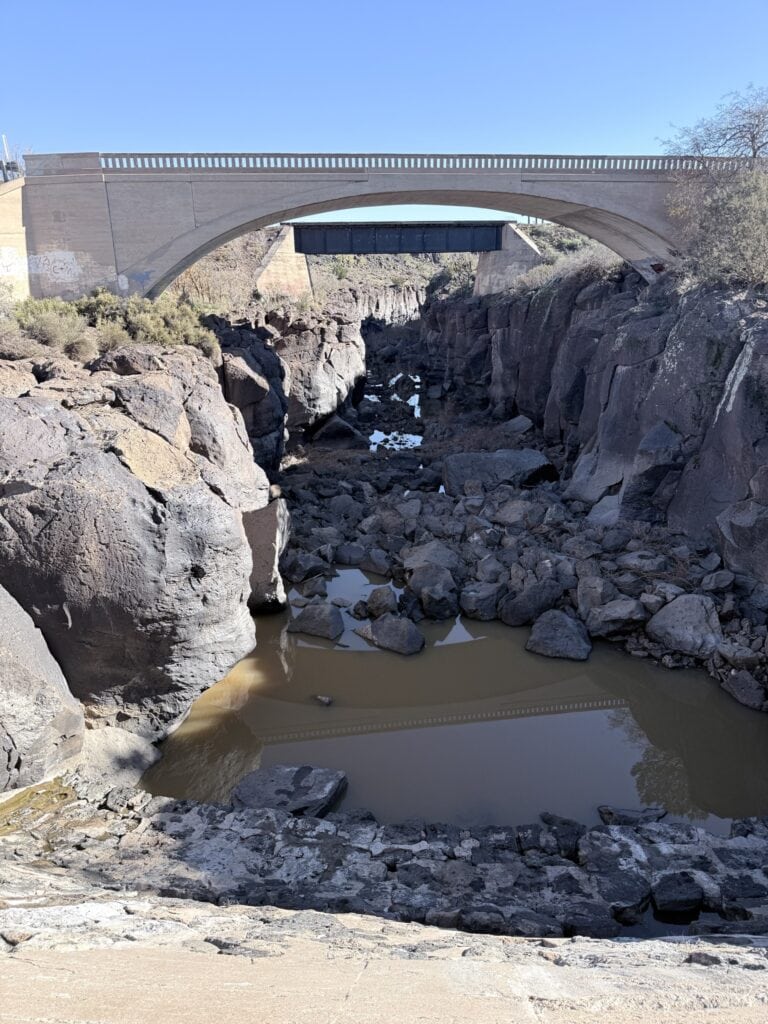
Two old bridges over the canyon
Just east of the dam, Old Highway 89 crosses the canyon on the Verde River Bridge, a concrete arch with a 100-foot span. It was built in 1922 for the old highway north from Prescott, and it was listed on the National Register of Historic Places in 1988 as one of Arizona’s historic highway bridges. The current State Route 89 crosses the river about half a mile away.
Right beside it is an old railroad bridge, a reminder that the Santa Fe’s rail line once ran through here too. Old rail beds matter to trail planners: the state’s plans for the area include an abandoned rail bed that could carry a Peavine Trail extension north to the river.
Get the Insider in your inbox
Local events, new places, and weekend ideas in one friendly email.
Del Rio Springs and Arizona’s first capital
Sullivan Lake is close to one of the most important places in Arizona history. In December 1863, an Army detachment set up camp at Del Rio Springs, just north of today’s Chino Valley, and called it Fort Whipple. Territorial Governor John Goodwin’s party arrived in January 1864, and for a few months Arizona’s new territorial government ran out of this spring-fed valley before moving south to Prescott. Later the springs supplied water to Prescott, and then to a Santa Fe Railway subsidiary and the Fred Harvey Company, whose farm grew food for the Harvey hotels along the railroad. Our guide to things to do in Chino Valley has more on that history.
Arizona’s next state park
In March 2024, with help from the Trust for Public Land, the Arizona Legislature, Yavapai County and The Nature Conservancy, Arizona State Parks and Trails bought 734 acres of the old Del Rio Springs ranch land. The goals are to protect Sullivan Lake and the start of the Verde River, preserve the history of Del Rio Springs and early Arizona, and extend the Peavine National Recreation Trail about 25 miles, from Watson Lake and the Granite Dells in Prescott to the river’s headwaters. The land is slated to become Verde River Headwaters State Park.
More pieces have come together since. In 2025 the Town of Chino Valley bought 23 acres inside the park boundary that hold the historic Fred Harvey farm buildings. In September 2026, the town announced it now owns 10.5 acres of Upper Sullivan’s Canyon, right next to the lake. That stretch of the canyon is lined with columns of basalt that climbers have used for decades, and it holds petroglyphs, cave shelters and the remnant of a historic railroad bridge. The Prescott Climbers Coalition will help care for it.
Arizona State Parks and Trails says it will plan the park with public input. There’s no opening date yet.
Visiting Sullivan Lake
Old Highway 89 runs north from Chino Valley, east of the current highway, and crosses the canyon on the 1922 bridge about 2.7 miles south of Paulden. From the road you can see the canyon, the two bridges and, to the west, the dam and the lake basin.
- The park isn’t open yet. The land around the lake belongs to Arizona State Parks and Trails and hasn’t been developed, so there are no restrooms, parking lot or maintained trails. Respect any posted signs, and check Arizona State Parks and Trails for updates before you go.
- Don’t park on the bridge. Pull completely off the road where it’s safe.
- Stay out of the canyon after rain. This is where the whole Big Chino drainage drains, and water can come up fast during monsoon storms and winter floods.
- Watch your step. The basalt is sharp and uneven, and there’s no maintained path along the rim.
- Leave the ruins alone. The clubhouse walls are almost a century old, and loose stone can fall.
Sullivan Lake makes an easy add-on to a Chino Valley day: walk part of the Peavine Trail, have lunch in town, and drive north to see where the Verde begins. If you’re continuing north, it’s on the way to the Route 66 towns of Ash Fork and Seligman.
Who was Sullivan Lake named for?
According to Sharlot Hall Museum historian Stan Brown, the name goes back to J. W. “Jerry” Sullivan, a pioneer cattleman whose ranch spread across the Williamson and Chino valleys. Sullivan was born in Picton, Ontario, in 1843 and came to Yavapai County from New Mexico in the summer of 1868. He started the 0-0 brand in Williamson Valley, and the museum says those were believed to be the first cattle in the valley. His range eventually covered 150,000 acres or more.
Sullivan was also a Yavapai County supervisor and a director of the Bank of Arizona, and he served two terms in the Arizona House of Representatives, in the 3rd and 4th State Legislatures (1917–1920). In his second term he was Speaker Pro Tempore. He never married, and he died in Prescott in October 1929, a few years before the dam that carries his name was built. If your family has stories or photos from the lake’s early years, tell us. We’d love to add them.
Sullivan Lake questions
Where is Sullivan Lake?
On Old Highway 89 between Chino Valley and Paulden in Yavapai County, about 25 miles north of downtown Prescott. The dam sits just west of the 1922 bridge, about 2.7 miles south of Paulden.
Who is Sullivan Lake named after?
J. W. “Jerry” Sullivan (1843–1929), a pioneer rancher in the Williamson and Chino valleys who served two terms in the Arizona House of Representatives (1917–1920).
Is Sullivan Lake where the Verde River starts?
Yes. The Verde River begins just below Sullivan Dam, where the Big Chino and Williamson valleys drain into a basalt canyon. The year-round flow starts a little farther downstream, where springs feed the river.
Can you fish or swim at Sullivan Lake?
Not really. The lake silted up within a few years of being built, and today it’s a shallow basin that’s often dry. The land is part of a future state park that isn’t open yet.
What are the stone ruins at Sullivan Lake?
They’re the walls of a clubhouse the Prescott Sportsmen Club planned in the 1930s, plus stone duck blinds. Work stopped before the building got a roof, and it was never finished.
When will Verde River Headwaters State Park open?
There’s no date yet. Arizona State Parks and Trails bought the land in 2024 and says it will plan the park with public input.
Sources: Arizona State Archives (Arizona Memory Project), Federal Emergency Relief Administration photograph of Sullivan Dam, 1935; Sharlot Hall Museum archives, Sullivan Lake dam construction photographs, c. 1934–1938; National Register of Historic Places, Verde River Bridge (1988); Arizona State Library, “Arizona Legislators: Then & Now” (Jerry W. Sullivan); Stan Brown, “Route 89 History from Chino Valley to Ash Fork,” Sharlot Hall Museum Days Past (2011); Arizona State Parks and Trails, Del Rio Springs; The Prescott Times (March 2024 and March 2025); Signals AZ and the Town of Chino Valley (September 2026); “The Mysterious Ruins at Sullivan Lake,” #PrescottAZHistory (2016), which draws on Ruth Gilpin’s Paulden Pioneers (1999). Checked November 2026, with photos from our own visit.
Something changed? Let us know
Enjoyed this? Get more Prescott in your inbox
Weekend picks, new places, and local events from people who love Prescott. Free, and you can unsubscribe anytime.